The Great Modern Tragedy: Letting Others Live
Humanity has reached a spectacular level of evolution. Before, people survived by hunting mammoths; now we survive by ignoring problems while scrolling on our phones at three in the morning.
We live in extraordinary times. The planet is heating up, rents seem designed for billionaires, working eight hours no longer guarantees making it to the end of the month, and anxiety has practically become a domestic pet. But don't worry: the most important thing is that a celebrity has posted a mysterious photo on Instagram and we need to analyze it as if it were a top-secret state document.
Modern society functions thanks to a delicate balance between absolute chaos and our incredible ability to pretend everything is normal. There are people who eat coffee, bad news, and a spike in electricity prices for breakfast, and yet still reply "fine, hanging in there" when asked how they are.
Governments promise solutions with the same conviction with which people promise to start the gym in January. Everyone knows it won't happen, but we keep pretending to be enthusiastic because shared lies build community.
And then there are social networks, that magical place where someone can have an emotional breakdown because they lost followers while another person explains they can't afford rent. Priorities in perfect balance.
The most fascinating thing is our capacity for adaptation. Humans can get used to any disaster as long as they have Wi-Fi. The healthcare system collapses, inflation rises, working conditions worsen... but as long as the video loads in HD, we keep moving forward like true professionals of decadence.
Laughter makes the disaster more bearable. But perhaps the problem isn't just the crisis. Perhaps the real problem is that we've grown so accustomed to it that it's now part of the landscape.
There are news stories that surprise us. Scientific discoveries, medical breakthroughs, people who still know how to park without taking up two spaces... and then there are those other news stories that shouldn't still exist but which, unfortunately, keep appearing like bills at the end of the month: campaigns against LGTBI-phobia.
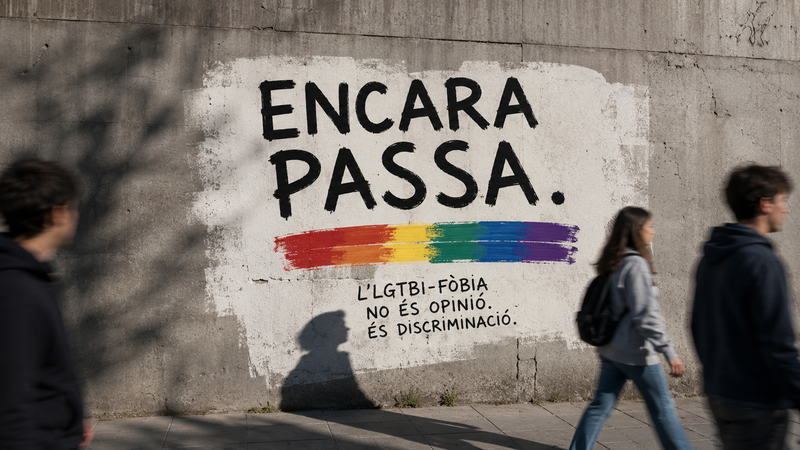
This year, the Government of Andorra has launched the "Encara passa" (It Still Happens) campaign, aimed at making situations of discrimination against the LGTBI community visible. The name is spot on. Short, direct, and sadly necessary. Because yes, it still happens. There are still people unable to get over the traumatic fact that two people love each other or that someone chooses to live their identity freely. A national tragedy, apparently.
The campaign reproduces everyday situations of discrimination that often go unnoticed or are normalized. And that is the most fascinating thing of all: the human capacity to turn intolerance into a habit. Like someone who no longer hears the hum of the fridge because they've lived with it for years.
"Joking" comments. Glances. Laughs. The classic "I have nothing against it, but...", probably one of the most dangerous phrases in the modern language. An expression that is always followed by some monstrosity worthy of a 2007 internet forum.
The most spectacular thing is that many people still think LGTBI-phobia no longer exists. Of course. Just like sexism, racism, and post-Christmas diets. All solved. Congratulations, humanity.
There are people who sincerely believe that demanding respect is "exaggerating." Because apparently there are people who consider being able to insult or discriminate freely as part of freedom of speech. A curious idea, especially since it usually comes from people who get offended if their whole milk is swapped for semi-skimmed.
And while some say that "you can't say anything nowadays," the statistics, reports, and real experiences continue to prove exactly the opposite. There are still teenagers afraid to say who they are. There are still people who avoid holding their partner's hand in public. There are still families who turn love into an interrogation. But don't worry, I'm sure the problem is that there are too many colorful flags once a year.
The campaign also highlights available resources: support emails, helplines, and associations like Diversand and Horitzons, which work so that people can live with something apparently revolutionary: dignity.
And here comes the truly absurd part of this whole story: that such campaigns are still needed. Imagine explaining this fifty years ago. "Look, in the future we'll have artificial intelligence, electric cars, watches that count steps, and people arguing on the internet because two women are kissing." Spectacular technological evolution. Mental evolution... we're getting there.
Modern society is strange. You can go to space, pay with your phone, or watch a movie in 4K from the toilet, but there are still people unable to accept that not everyone lives, loves, or feels the same way they do. It's like discovering nuclear fire and still being afraid of a rainbow.
The problem with discrimination isn't just the obvious insult. It's also the comfortable silence. The nervous laugh. The "it's not that big a deal." The collective ability to look the other way because deep down it's easier not to complicate one's life. Until the problem affects you, your child, your sister, or your friend. Then it suddenly stops being "a modern exaggeration."
And that is precisely why campaigns like "Encara passa" exist, promoted by the Government of Andorra for International Day Against LGTBI-phobia. A simple, direct, and quite revealing name. Because yes, it still happens. There are still comments disguised as "humor," uncomfortable looks, jokes that aren't funny, and that widely practiced national sport consisting of judging other people's lives while one's own looks like a series canceled mid-season.
Curiously, there are jokes that are only funny to the person telling them.
The strangest thing is that many people remain convinced that discrimination is a thing of the past. Like DVDs or modems that made demonic noises. But it turns out it isn't.
It is admirable, in a way, this human capacity to complicate what shouldn't be complicated.
And perhaps that is what the campaign tries to remind us: that normality shouldn't mean enduring hate in silence. That respecting others is not a favor or an ideology. It's the bare minimum required to coexist without turning society into an eternal school playground.
Because yes, it still happens. And the fact that it continues to happen in 2026 is not just ridiculous. It is deeply sad... the day a campaign like this is no longer necessary will be when we can truly say we have advanced something more than just internet speed.
The campaign also reminds us of something important: behind every "innocent comment" there are real people. People who often grow up hearing that they are "strange," "too sensitive," or "different." And a point comes where the problem is no longer a specific insult, but the constant erosion of having to justify one's own existence to a society that often examines too much and listens too little.
But it's not about turning everything into an eternal internet war, either—we have enough of those with arguments over pineapple on pizza. The message is much simpler: respect doesn't cost that much. In fact, it probably consumes less energy than getting outraged over a stranger's private life.
The saddest thing of all is that it's still necessary to remind people of this with official campaigns. Because that means that, despite progress, there are still situations that continue to happen too often and too silently.
Behind every "innocent comment" there are real people. People who often grow up hearing that they are "strange," "too sensitive," or "different." And a point comes where the problem is no longer a specific insult, but the constant erosion of having to justify one's own existence to a society that often examines too much and listens too little.
And yes, we can use humor. In fact, humor is one of the best tools for exposing absurd contradictions. But good humor doesn't need to humiliate anyone. Intelligent sarcasm doesn't aim at those suffering discrimination, but at the ridiculous need to continue discriminating.
Because in the end, the question isn't why these campaigns exist.
The real question is: how can it be that they are still necessary?
Comments
No comments yet. Be the first to comment!